Art and Design
NC Programme of Study Aims
The national curriculum for art and design aims to ensure that all pupils:
- produce creative work, exploring their ideas and recording their experiences
- become proficient in drawing, painting, sculpture and other art, craft and design techniques
- evaluate and analyse creative works using the language of art, craft and design
- know about great artists, craft makers and designers, and understand the historical and cultural development of their art forms.
Curriculum
At All Saints’, our Art and Design curriculum encourages pupils to explore, experiment, create and develop their own ideas while building a secure understanding of artistic techniques, processes and design. We follow Kapow Primary, with units taught in carefully planned blocks to give children time to immerse themselves in the creative process and develop their work in depth.
Pupils develop practical skills across a range of disciplines, including drawing, painting, sculpture, collage, textiles, craft and design. They build an increasingly sophisticated understanding of the formal elements of art, including line, shape, form, colour, tone, texture, pattern and space, learning how these can be manipulated to achieve different effects and communicate ideas.
Alongside making, children develop their knowledge of artists, craftspeople and designers from different periods, cultures and traditions. They explore how and why creative work is produced, make connections between the work of others and their own ideas, and use this knowledge as inspiration rather than simply reproducing an existing style.
Art books/ Sketchbooks are used to investigate, experiment, practise techniques and develop ideas. Pupils are encouraged to make creative choices, take risks and refine their work as it progresses. Evaluation and reflection are integral to the creative process: children discuss their own work and that of others, use appropriate artistic vocabulary and consider how their work could be adapted or improved.
In EYFS, Art and Design is developed primarily through Expressive Arts and Design, with important links across the seven areas of learning. Children have regular opportunities to explore materials, tools, colour, texture, pattern and form, developing the creativity, fine-motor control and confidence that provide strong foundations for the Art and Design curriculum in Key Stage 1 and beyond.
The expected impact of following the Kapow Primary Art and design scheme of work is that children will:
- Produce creative work, exploring and recording their ideas and experiences.
- Be proficient in drawing, painting, sculpture and other art, craft and design techniques.
- Evaluate and analyse creative works using subject-specific language.
- Know about great artists and the historical and cultural development of their art.
- Meet the end of key stage expectations outlined in the National curriculum for Art and design.

Y3 have carefully selected and curated fabrics, colours, textures and images inspired by our topic ‘Life in the Freezer’ to create a mood board.
“We experimented with colour mixing to create a colour palette to express many tones and shades we associate with these cold environments.”
“We researched the different wildlife and wanted to capture a range of emotions by selecting images carefully.”

Immersing in the sights and sounds of the rainforest, Y4 children are inspired to create a series of drawings, forming their ideas into a mood board.
“I like using different textures and fabrics because it was exciting to have a different feel, the leopard paper gave a realistic touch!“

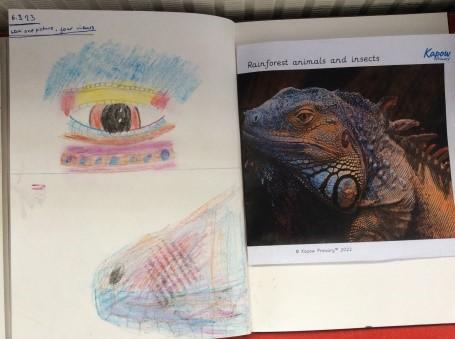
They go on to explore how drawing can develop ideas for pattern design; they have drawn one rainforest animal from four different perspectives.
“I like how I used different shadings and I rubbed them together to make it more realistic I did a lizard, I found the eye challenging because there was so much detail!”
“I enjoyed spending lots of time on all the detail and I liked how we got to use lots of equipment to make it look realistic like the crayons!”
|
|
|
|


In November Year 6 went to Tate Britain, to visit the Hew Locke installation called The Procession, as part of our learning on the Slave Trade, with cross- curricular Art.
The children made sketches of their favourite figure. These were some of their observations from the day:
"The Tate was built using money from the Tate & Lyle sugar company, which was part of the slave trade. I was impressed by the effort that had been put into display; I most enjoyed the breathtakingess of it!" By Albert
“I most enjoyed the shock we had when we first arrived in the gallery. I learnt that sculpture can be made out of any material and old scraps. Fabrics are one of the best materials. We are going to make our own statues so this has prepared us.” By Karim
|
|
|

